

Supply 99% Retinal/Retinaldehyde Powder
How Much Do You Know About Retinal?
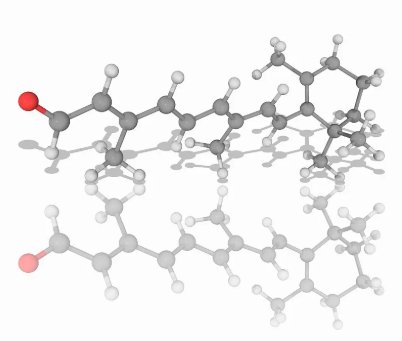
Retinal, also known as vitamin A aldehyde, is a key derivative in the vitamin A metabolic pathway, with the molecular formula C₂₀H₂₈O. It can be generated from β-carotene through an oxidative cleavage reaction, and can be further reduced to retinol (vitamin A) or oxidized to retinoic acid (retinoic acid) in the body. Due to its structural and functional similarity to retinoic acid, retinal is considered the vitamin A derivative closest to retinoic acid, but it is less irritating and more suitable for sensitive skin care. Retinal is widely used as an active ingredient for anti-wrinkle, anti-aging, and anti-acne purposes. Retinal powder is gentler on the skin and can be converted into retinoic acid in the body, exerting multiple effects such as regulating keratinization, improving photoaging, and reducing acne. It is a skin care ingredient that combines efficacy and tolerability.
Product Features
Highly Efficient Conversion
As an oxidized derivative of retinol, retinal has a more direct metabolic pathway in the body, requiring only one enzymatic reaction to be converted into highly bioactive retinoic acid (retinoic acid). Studies have shown that its conversion efficiency is approximately 11 times that of retinol, enabling it to initiate anti-aging and other related physiological functions more rapidly. Furthermore, excess retinaldehyde in the body can be reduced to retinol for storage, helping to prevent excessive accumulation of active ingredients and maintain the metabolic balance of skin tissue.
Stability
Retinal contains multiple unsaturated double bonds in its chemical structure, making it prone to cis-trans isomerism and sensitive to environmental factors such as light and heat, resulting in poor stability. To improve its activity and durability in skincare products, it is often protected using formulation technologies such as liposome encapsulation.
Basic Properties
Retinal has the molecular formula C₂₀H₂₈O and appears as orange crystals or a liquid. Its structural characteristics result in it being almost insoluble in water, but readily soluble in oils and common organic solvents (such as ethanol and chloroform). This property also affects its distribution in vivo and its formulation in cosmetics.
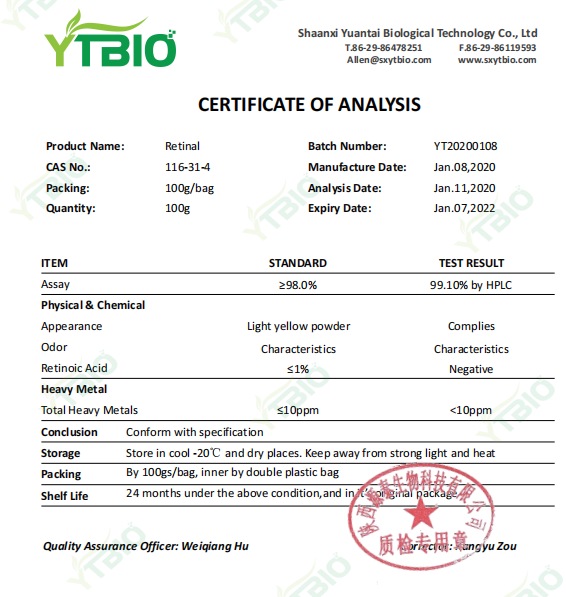
YTBIO: Providing High-Quality Retinal powder and Services
Retinal: Multiple Physiological Functions
Visual Health
Retinal is an important component of rhodopsin in retinal photoreceptor cells, combining with opsin to form visual pigments. Under light conditions, retinal undergoes an isomerization reaction, converting light signals into neural electrical signals, which are then transmitted to the brain to form visual images. This mechanism is crucial for dark adaptation and night vision; retinal deficiency may lead to night blindness or decreased dark adaptation.
Skin Health
Anti-aging and Skin Texture Improvement
Retinal effectively promotes collagen synthesis, enhances skin elasticity, and accelerates epidermal cell renewal, thereby reducing fine lines and wrinkles, improving rough and dull skin, and making skin firmer and smoother.
Oil Control and Anti-acne Effects
This ingredient has the ability to regulate sebum secretion and inhibit the activity of Propionibacterium acnes, helping to reduce clogged pores and inflammation, providing comprehensive improvement for oily skin and acne problems.
Antioxidant and Photoprotection
Retinal also enhances the skin's self-repair ability against UV damage, reducing problems such as age spots and abnormal texture caused by photoaging.
Mildness and Suitability
Compared to traditional retinoids like retinoic acid, retinal powder exhibits superior skin tolerance with significantly reduced irritation, making it more suitable for long-term use on various skin types, including sensitive skin. It undergoes a single conversion in the body to produce retinoic acid, combining high efficacy with gentleness. Therefore, it is frequently recommended for use in anti-wrinkle and anti-acne skincare products, with common concentrations ranging from 0.05% to 0.15%.
Retinal: Application Areas
Dermatology and Skincare
Retinal powder plays a central role in skin health management, with a well-defined mechanism of action and significant effects. In skincare applications, it effectively promotes collagen synthesis and epidermal cell renewal, thereby improving skin elasticity, reducing wrinkles and fine lines, and helping to even out skin tone. Simultaneously, this ingredient plays a preventative and therapeutic role against common skin problems such as acne by regulating sebum secretion, inhibiting Propionibacterium acnes activity, and reducing inflammation. Clinical studies show that appropriate concentrations of retinaldehyde preparations perform excellently in improving photoaging and acne, and have better skin tolerance compared to retinoic acid.
Visual Health
In the visual system, retinal is a key structural component of rhodopsin, directly involved in the light signal transduction process. This function makes it indispensable in maintaining normal dark adaptation and retinal health. Clinically, it is also used to prevent and treat vitamin A deficiency-related night blindness and dry eye syndrome, among other eye diseases.
Nutritional Science and Other Applications
As the active form of vitamin A, retinaldehyde is used in human nutritional supplements and animal feed, helping to support immune function, promote growth and development, and maintain normal visual function. Furthermore, in the scientific research field, retinaldehyde is an important tool molecule for studying visual physiology and photochemical mechanisms, and its photosensitizing properties also offer possibilities for the development of novel photofunctional materials.

